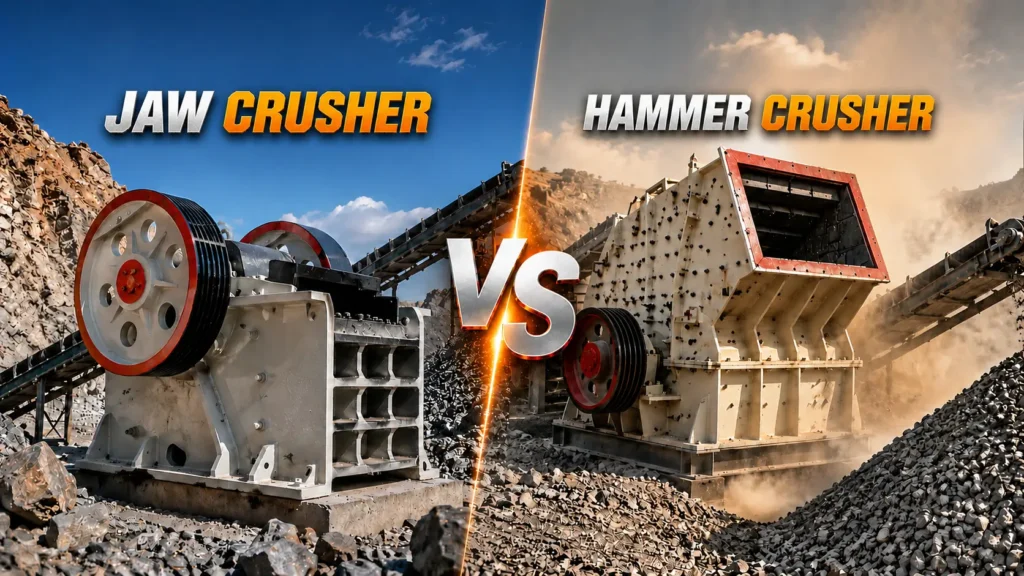
Selecting the right crushing equipment plays a crucial role in the success of any mining, quarrying, construction, or material processing operation. Many industries often compare a jaw crusher and a hammer crusher before making an investment because both machines serve different purposes in the crushing process.
Understanding the Difference Between Jaw Crusher and Hammer Crusher helps businesses improve productivity, reduce operating costs, and achieve the desired output size. At Pashacontractors, we provide industrial crushing solutions for clients in Rajkot, Delhi, and across India. Our engineering team helps industries select the most suitable crushing equipment based on their material handling requirements.
Understanding Jaw Crushers and Hammer Crushers
Both jaw crushers and hammer crushers reduce large materials into smaller sizes. However, they use different crushing methods and perform best under different operating conditions.
A jaw crusher primarily handles coarse crushing and serves as the first stage of a crushing plant. A hammer crusher performs medium and fine crushing by using high speed rotating hammers to break materials.
Understanding these operational differences is the first step in evaluating the Difference Between Jaw Crusher and Hammer Crusher.
How a Jaw Crusher Works
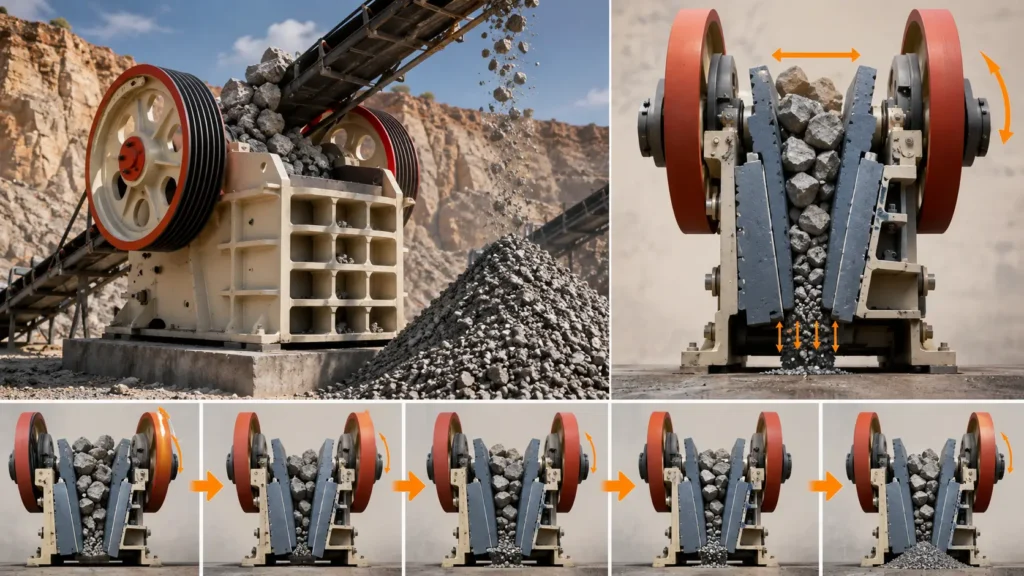
A jaw crusher uses compressive force to crush materials. The machine consists of a fixed jaw and a moving jaw. As the moving jaw approaches the fixed jaw, it compresses the material between them and breaks it into smaller pieces.
Jaw crushers are widely used in:
- Mining operations
- Quarry applications
- Construction projects
- Aggregate production plants
- Mineral processing facilities
Industries prefer jaw crushers for handling hard and abrasive materials such as granite, basalt, iron ore, and river stone.
How a Hammer Crusher Works
A hammer crusher operates using impact force. Rotating hammers strike the material at high speed and break it into smaller particles. The crushed material then passes through screens that control the final product size.
Hammer crushers commonly process:
- Limestone
- Coal
- Gypsum
- Chalk
- Soft and medium hard materials
The impact crushing mechanism allows hammer crushers to produce finer output in a single stage.
Key Differences Between Jaw Crusher and Hammer Crusher
Several factors separate these two crushing machines. Understanding each factor helps businesses select the right equipment for their operations.
| Feature | Jaw Crusher | Hammer Crusher |
| Crushing Principle | Uses compression force between a fixed jaw and a moving jaw to crush materials. | Uses high-speed rotating hammers to break materials through impact force. |
| Material Suitability | Ideal for hard and abrasive materials such as granite, basalt, quartz, and iron ore. | Best suited for soft to medium-hard materials such as limestone, coal, gypsum, and chalk. |
| Feed Size Capacity | Accepts large feed sizes and can handle oversized rocks directly. | Requires smaller feed materials for efficient operation. |
| Output Particle Size | Produces relatively coarse output and often requires secondary crushing. | Produces finer and more uniform output in a single stage. |
| Production Stage | Commonly used as a primary crusher in crushing plants. | Often used for secondary crushing or fine crushing applications. |
| Wear Rate | Lower wear rate due to the compression crushing method. | Higher wear rate because hammers continuously impact the material. |
| Maintenance Requirements | Requires less frequent maintenance and part replacement. | Requires more frequent replacement of hammers and wear components. |
| Energy Consumption | More energy-efficient when processing hard materials. | May consume more power due to high-speed rotor operation. |
| Production Capacity | Suitable for high-capacity crushing of hard materials. | Efficient for moderate-capacity crushing of softer materials. |
| Initial Investment | Usually has a higher purchase cost. | Generally has a lower initial equipment cost. |
| Operating Cost | Lower long-term operating and wear-part costs. | Higher maintenance and wear-part replacement costs. |
| Dust Generation | Produces comparatively less dust during operation. | Generates more dust due to high-speed impact crushing. |
| Application Industries | Mining, quarrying, construction aggregates, and mineral processing. | Cement plants, coal handling plants, limestone processing, and fertilizer industries. |
| Best Use Case | When crushing large, hard, and abrasive materials. | When producing fine material from soft or medium-hard materials. |
When Should You Choose a Jaw Crusher?
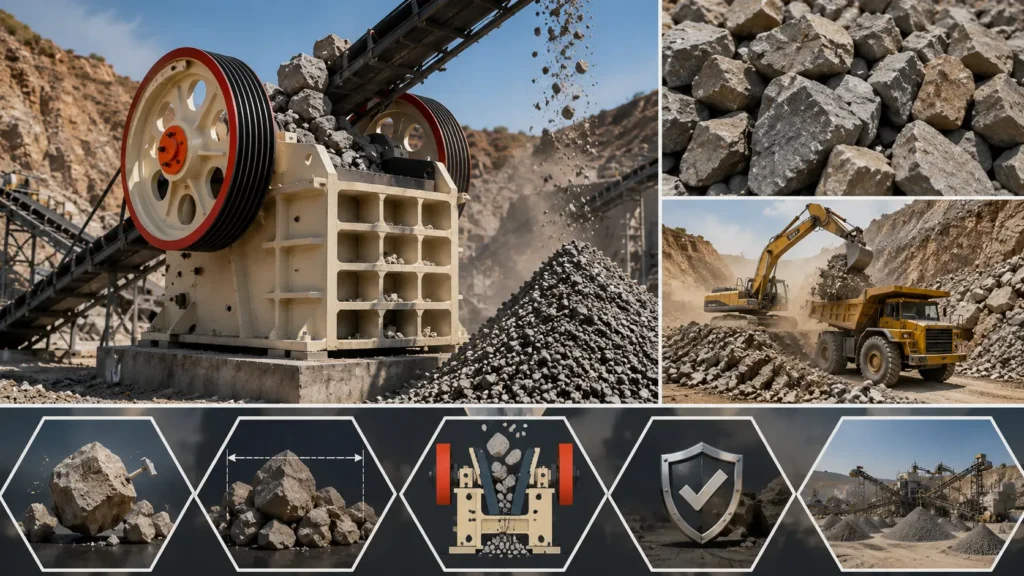
A jaw crusher is often the best choice when:
- Processing hard and abrasive materials
- Handling large feed sizes
- Performing primary crushing
- Requiring high durability
- Operating in mining and quarry environments
Many crushing plants use jaw crushers as the first stage in the material reduction process.
When Should You Choose a Hammer Crusher?
A hammer crusher becomes the ideal solution when:
- Processing soft to medium hard materials
- Producing fine output sizes
- Reducing equipment complexity
- Seeking single stage crushing solutions
- Handling coal, limestone, or gypsum
Hammer crushers help reduce processing steps and simplify plant layouts.
Jaw Crusher vs Hammer Crusher: Comparison Table
| Feature | Jaw Crusher | Hammer Crusher |
| Crushing Method | Compression | Impact |
| Material Type | Hard Materials | Soft to Medium Materials |
| Feed Size | Large | Medium to Small |
| Output Size | Coarse | Fine |
| Wear Rate | Lower | Higher |
| Maintenance | Lower | Higher |
| Energy Efficiency | Better for Hard Materials | Better for Soft Materials |
| Application | Primary Crushing | Secondary or Fine Crushing |
Choosing the Right Crusher for Your Industry
The ideal crusher depends on your material characteristics, production targets, budget, and plant configuration.
If your operation processes hard rock and requires primary crushing, a jaw crusher offers better performance and durability.
If your operation handles softer materials and requires finer output, a hammer crusher can provide greater efficiency and simplified processing.
Evaluating these factors carefully ensures maximum return on investment and improved plant productivity.
Pashacontractors: Reliable Crushing Equipment Solutions
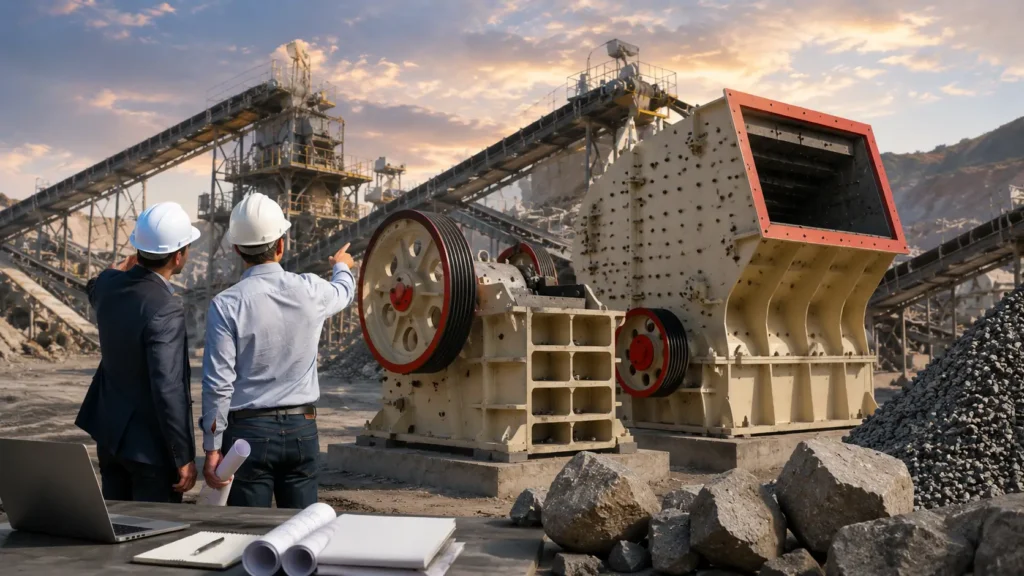
At Pashacontractors, we provide customized crushing equipment solutions for industries throughout Rajkot, Delhi, and across India. Our team understands the practical challenges faced by mining, quarrying, cement, and construction businesses.
Whether you need assistance selecting a jaw crusher, hammer crusher, or a complete crushing plant, our experts can recommend the most effective solution for your operational requirements.
Contact Pashacontractors today to discover reliable crushing technology designed to improve productivity, reduce maintenance costs, and support long term industrial growth.


